


Real estate runs on speed and trust. The agent who answers first usually wins the lead. The brokerage that prices a property correctly closes faster. The team that spots a serious buyer early stops wasting time on people who will never sign. For decades real estate businesses handled all of this with gut feeling and manual work. That era is ending fast.
Artificial intelligence has moved from a buzzword into a daily tool across the U.S. market. A 2026 survey from the National Association of Realtors found that 82% of real estate agents now use AI in some part of their business. On the commercial side the shift is just as sharp. A 2026 study by First American and DealGround found that 66% of U.S. commercial real estate professionals already use AI weekly or daily. McKinsey estimates that generative AI could create between $110 billion and $180 billion in value for the real estate industry.
The opportunity is clear. The problem is that most firms still use generic tools that do not fit how they actually work. This article breaks down the real problems U.S. real estate businesses face, the AI products that solve them, and how you should plan a strategy that closes more deals.
The Real Problems Real Estate Businesses Face Today
Before you adopt any technology you need to name the pain. Most real estate companies struggle with the same five issues.
Slow lead response kills conversions. A buyer fills out a form on Zillow or your website and then waits. By the time an agent calls back the buyer has already contacted three other agents. Response speed is one of the strongest predictors of who wins the deal.
Agents waste time on weak leads. A typical CRM holds hundreds of contacts. Most will never buy. Agents burn hours chasing browsers while serious buyers slip away unnoticed.
Pricing is inconsistent and emotional. Sellers want a high number. Agents sometimes agree just to win the listing. Overpriced homes sit on the market, rack up days on market, and force price cuts that hurt everyone.
Marketing and listings eat up resources. Writing MLS descriptions, staging homes, and producing tours costs real money and time. Physical staging alone can run thousands of dollars per property.
Decisions rely on guesswork. Investors and developers often commit large sums based on instinct rather than data. One wrong call can erase a year of profit.
These problems share a single root cause. Real estate generates huge amounts of data but most firms cannot use it well. AI products fix exactly that.
How AI Products Solve These Problems
Here is where technology earns its place. Each AI product maps directly to one of the problems above.
Faster Response With AI Chatbots and Virtual Assistants
An AI assistant answers buyer questions the moment they arrive. It works at 2 am, handles hundreds of chats at once, and never forgets to follow up. Research summarized in a 2025 review found that AI chatbots inside real estate CRM systems can improve lead conversion rates by up to 40% and cut response time by 60%. A buyer who gets an instant answer stays engaged. A buyer who waits moves on to a competitor.
Smarter Lead Scoring
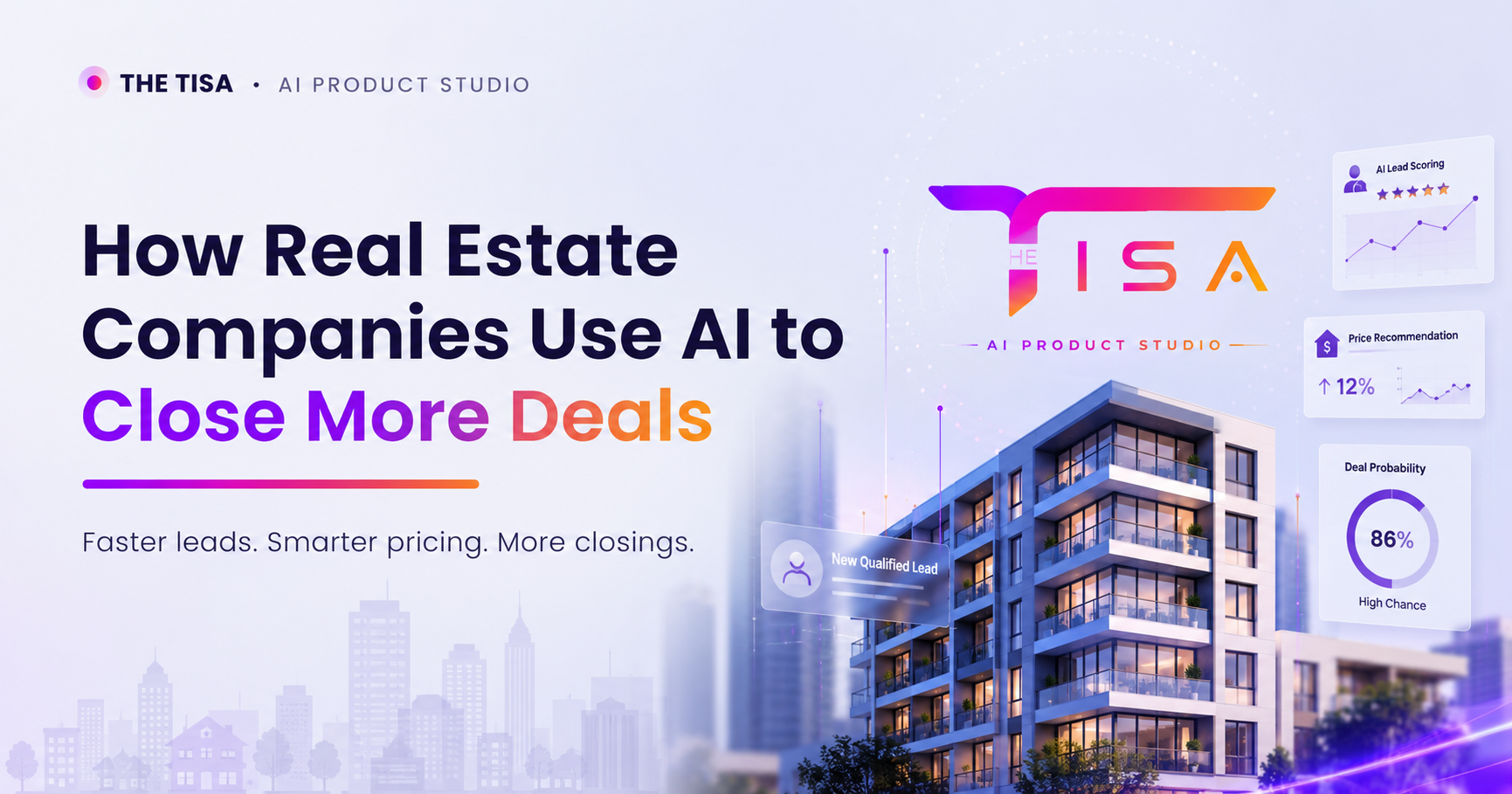
AI ranks your entire database in seconds. It studies behavior such as which listings a prospect views, how often they return to a property, and how long they spend on a valuation page. It then hands your agents a prioritized call list. One major U.S. brokerage franchise improved its lead scoring accuracy from 71% to 89% after adopting AI, which pushed more agent hours toward the buyers most likely to transact. Your team stops guessing and starts closing.
Accurate Pricing With Automated Valuation Models
AI valuation models price property using thousands of data points instead of opinion. Modern automated valuation models now land within 2% to 3% of a human appraiser on standard homes. Zillow reports a median valuation error rate near 2.4% on its Zestimate. Accurate pricing means faster sales and fewer listings that linger and trigger price reductions.
Cheaper and Better Marketing
Generative AI writes listing descriptions, ad copy, and email sequences in minutes. AI virtual staging fills empty rooms with furniture digitally and costs around 95% less than physical staging. Firms that use AI-driven recommendation engines report 35% to 50% higher lead engagement than traditional listing platforms. Smart virtual tours also cut wasted in-person showings by up to 60% because buyers screen properties online first.
Predictive Analytics for Better Decisions
AI forecasts price trends, rental yields, and buyer demand at the ZIP code and neighborhood level. Investors use these insights to spot opportunities early and avoid bad deals. This moves your business from reactive to predictive. You anticipate demand instead of chasing it.
The results add up. The same First American and DealGround study revealed something important though. Only 5% of CRE professionals trust AI enough to inform real deal decisions. That trust gap is the next problem you must solve, and it explains why generic tools are not enough.
Why Generic AI Tools Fall Short
Most firms grab an off-the-shelf chatbot or a free writing tool and call it an AI strategy. This rarely works for three reasons.
Generic tools do not understand your market. A national tool knows nothing about your local pricing, your buyer profile, or your inventory. Its output stays vague and your agents stop trusting it.
Generic tools do not connect to your systems. Your CRM, your MLS feed, and your marketing platform stay disconnected. Data sits in silos and the AI cannot see the full picture.
Generic tools raise compliance risk. U.S. real estate runs on strict disclosure rules and Fair Housing requirements. A tool that was not built for property work can produce content that breaks these rules and exposes you to liability.
This is why forward-thinking companies now invest in custom AI products built around their exact workflow. A custom solution learns your data, plugs into your existing tools, and follows your compliance rules. That is the difference between AI you experiment with and AI you trust with real deals.
How to Plan Your AI Strategy
You do not need to automate everything at once. A focused rollout beats a scattered one. Follow this five-step plan.
Step one. Identify your biggest bottleneck. Look at where deals leak. If leads go cold before contact, start with response automation. If agents chase the wrong people, start with lead scoring. Fix the problem that costs you the most money first.
Step two. Audit your data. AI is only as good as the data it learns from. Clean your CRM. Connect your MLS and listing history. Organize your buyer records. Strong data foundations decide whether your AI succeeds or fails.
Step three. Choose a custom build over a generic tool. Match the solution to your market and your systems. Work with a partner who understands both AI and U.S. real estate. The right product studio designs around your needs instead of forcing you into a template.
Step four. Start with a focused pilot. Pick one workflow and one team. Measure the results over 60 to 90 days. Track real metrics such as response time, conversion rate, and cost per closed deal. A small win builds internal trust and proves the value.
Step five. Scale what works. Once the pilot delivers, expand it across teams and add new use cases. Keep monitoring performance and refine the models as your market shifts. AI is not a one-time install. It improves the more you use it.
This staged approach also closes the trust gap. When your team sees real results from a focused pilot they stop treating AI as a gimmick and start treating it as a deal-closing engine. The PwC Emerging Trends in Real Estate report confirms that firms move from experimentation to real value once they prove ROI on a single workflow.
The Bottom Line
Real estate is becoming a data-driven business. The firms that win in 2026 and beyond will not be the ones with the most agents. They will be the ones with the smartest systems. AI products close the gap between a lead and a signed deal by responding faster, scoring smarter, pricing accurately, and predicting demand before competitors notice it.
The momentum is already visible in the numbers. AI-enhanced commercial platforms like Crexi have facilitated more than $540 billion in deal activity, and CBRE forecasts a significant pickup in U.S. transaction volume through 2026 and 2027 as firms adopt AI to operate more efficiently. The companies that build AI-ready systems today will capture most of that growth.
At “The TISA” we build custom AI products designed around the way real estate businesses actually work. We help you turn scattered data into a system that closes more deals. The technology is ready. The data proves the return. The only question left is whether you build your advantage now or watch competitors build theirs first.